Once again, we are becoming increasingly aware of the damage screen time can have on developing brains. (World Health Organization’s strict new guidelines–read them here)
You hear it from me and many, many others. And it is very real–the delay in cognitive development, the lagging behind of language acquisition, the brain development that is displaced, delayed, discouraged, the lack of ever-so-key self regulation, of managing in healthy ways all those feelings in life.
All due to the lack of hands on, sensory and language rich,
relationship based, whole body experiences. The way young children LEARN and grow. Optimally.
You know what I’m truly concerned about? How to help each of YOU, who perhaps have come to rely on screens to distract and entertain as you, exhausted, sick, feeling like you are drowning and with no extra moment in your day what-so-ever, have relied on a screen so you can at least… 
...breathe for a moment. Cook a meal. Use the bathroom by yourself. Talk with someone. Think. Sleep. Feel relieved because your child isn’t crying, screaming, hitting, driving you nuts. Drive safely. Arrive in one piece (more or less…. 🙂 ). Catch up on the overwhelming pile of laundry. Get dressed for work. DO work. Maybe even have a bit of adult conversation? With your partner?
I think about how, up until about 15 or so years ago (okay, maybe 20 or 25…), the only real screen we had to “rely” on was TV. And yet, in our family, TV was rarely used in those first few years, and pretty much limited to 30-minutes a day until in elementary school. And those 30-minutes were usually PBS shows such as Mister Rogers and Reading Rainbow. Totally awesome, by the way. Often watched WITH us rather than used for me to get something done.
And I can remember so much of what we DID do, instead of “relying” on TV, as we needed to find the time, space, relief in order to keep things going in our family. It is these I’d like to share…for I’m thinking many of you don’t have them in your repertoire because you’ve grown up with screens being the default. With so much information coming out about the detriment of screens for our young (and older!) children, how do you accomplish the seemingly impossible and only use screens minimally?
Ideas for you as you work at juggling the HARD of life:
…Try putting your upset baby or toddler into a backpack and onto your back while you cook dinner or tend to other things that need two hands. Now they are close to you, you can talk and sing a bit, offer them a snack, reach up and touch them. All the while taking care of work around the house. Connection. It can be made in many ways and it speaks volumes to your little one.
…Spend those first minutes home from work and daycare on the floor with your little one(s). Maybe shedding outdoor gear together. Maybe just staying quiet and watching them re-connect with home. Maybe stretched out on the floor with them climbing on you. Or reading a book together or staying out in the yard for some fresh air before you even head into the house.
Those minutes? Fully present to your little one? It answers their need for your connection during this transition. It buys YOU time afterwords, for they will more likely be calmer and engaged with helping you or exploring their books and toys. When they can count on a fully present parent helping them, first and foremost, with their transition home after a long day, those transitions become smoother. And THIS can give you the time you need.
…Have healthy snacks in the car for pick up after daycare and en-route home. That way your little one won’t be so hungry and at the end of their rope upon arrival at home. We always had apples, raisins, cheese, peanut butter and jelly sandwiches, yogurt…something easy to eat while tucked in a car seat. Yes, it can leave mess behind. Yet what a small price to pay that made our transition home go so much more smoothly. Now hunger wasn’t a part of it all AND what they ate was good for them, so I was less concerned about “ruining dinner.”
…Trying desperately to wrap up some work? A call? An email? Again, start with a moment of real connection. Sometimes just a few minutes of your full attention, asking your little one what they need, engaging with them is all it takes to give you the space you need to wrap up your work. And if they still are upset and you KNOW their physical needs have been met? Then let them know you hear them, they can stay near (maybe up in that backpack on your back!), and when you finish, you will tend to them once again. And then you do. Always keep your promises.
…In the car stuck in traffic or on a longer road trip? Oh the simple games to engage them with! What is seen out the window, in the sky; what they can anticipate at the NEXT stop sign, if they can see-see-see the scoop shovel dig-dig-digging. A snack to eat, a song to sing, books to look at. Play music! Or…just be quiet and let your child be upset as you breathe breathe breathe.
…Get creative with play–Let your toddler have a bowl, spoon, flour, and a bit of water to mix. Or maybe a few cheerios and water. It really doesn’t take much to provide your child with something they often find ever-so-captivating. At least for a moment or two. Sometimes up at the counter next to you with these same items or a squishy sponge or even just a cup of their own to drink is the connection they need while you tend to your responsibilities next to them.
We liked to fill a saucepan with a few kitchen items–measuring spoons and cups for instance–then on went the lid, down we plunked it in the middle of the kitchen floor and then I could turn back to tending the dinner.
Sometimes all we did was turn on a flashlight and hand it to our toddler or preschooler.Or a magnifying glass–that really got their attention as they focused on making things look BIG 🙂
Putting a blanket over the table or a pair of chairs and hiding a favorite stuffed toy and a few books underneath caught my daughters’ attention immediately. As did lining up a few of their toy animals in a parade underneath that blanket.
A doll with a washcloth and a small tub with a tiny bit of water in it (a TINY bit if you want the mess to be minimal) has many young toddlers fascinated.
 Have play dough available. Ever so soothing. Squish and poke and roll right up at the counter with you or settled in a high-chair or kitchen table.
A favorite for many is putting music on–what you can sing to, soothing if necessary, or to bop around the house getting things done. Or try an audio book for your child to tune into…and for you to talk about, too, as you move about the house.
Have paper and markers or crayons ready to roll. Or a collection of paper bags for them to scrunch, fill, dump, roll, wear. Scotch tape is a fun addition!
All of this? It requires a few things from you.
Letting go of various stages of MESS (or getting extra amazing at choosing things that leave no mess!). Simplifying meals. Being okay in Big Feelings. Being tired and knowing it really is temporary. Maybe a long temporary, and still temporary  . It requires you to trust yourself, your child, the chaos for what it is–just chaos. It asks you to take MANY deep breaths. Many.
The cool thing? With your attempts to minimize screens, you will discover it can get easier. Easier because your children are more in charge of themselves, tapping into their creativity and imagination, feeling in connection with YOU, learning and growing and managing all their feelings in healthy and productive ways. And as our kids grow these abilities, our job actually gets easier because they become increasingly independent in amazing and necessary ways. Our children are growing well.
Then when all bets are off, exhaustion is too over the top, life is absolutely insane…a screen is okay.
Now using a screen is a treat, limited, useful, and no longer displacing all the hands-on, sensory and language rich, relationship based, whole body experiences our children need in order to grow well.

I hope you will share right here what works in your family to manage through the chaos without relying on a screen. Share your successes, your attempts, anything that you’ve done to minimize screens and maximize GROWTH. A valuable resource for you is the Children’s ScreenTime Network. And find even more ideas here: MORE of What TO Do Instead of a Screen.
Sometimes it is the littlest thing that can make the biggest difference for a parent.
With appreciation and JOY,
Alice
Author and Parent Coach
©2019 Alice Hanscam




 ou are cruising right on through the store, gathering all you need…and then one raisin drops onto the floor. You automatically swoop down, pick it up and let your little one know, “Oops! This fell. Into the trash it goes.” And you continue on. The second raisin follows the first…maybe a third, as you continue with the same response, half paying attention because you are busy checking prices, choosing items, looking at your list.
 ES your child nods, off they run across the playground and then your child slows, glances over her shoulder, looking at you with the hesitation of “Is this okay? Am I safe? Should I keep going…?”.
 o go. You only half-hear the ramping up behind you. The “DON’T!” The “It’s MINE.” The “You better STOP!!!!” Next thing you know you have two kids fighting, crying, and tumbling all over each other to get to you. A big puddle of a mess that leaves you feeling frustrated; leaves them a wreck.


 ...how my young toddlers would pull to standing next to their book shelf and take the books off–plunk plunk plunk–one at a time to drop on the floor.
 goodbyes each morning were increasingly pleasant. She and her daughter had a few nice conversations in the car. And her daughter began to show up closer to the 7:30 mark every single day.
 Maybe you’d feel clearer about what it is that needs to happen; able to let go and trust a bit more; or just relieved. Maybe that’s all, just relieved. What a difference that can make, for relief bring relaxing. Relaxing opens you up and allows you to feel more receptive. And NOW real help can enter in.
 perform” via, perhaps, saying “Sing them the song!” or “Can you show them how you can sing it? Come on…you know the words…” instead turned into an opportunity for her toddler to decide–on his own–just what he felt like doing with no cajoling or bribing or pressure.
 the BLUE piece go?” And waited patiently as Mr. 2 studied, pointed, and delighted in being asked.


 ~ It makes me feel so special (until it becomes embarrassing but that’s a whole other lesson learned) when you pick me up from school and can listen to me without telling me to wait for you to finish texting. I burst out of school to run to the car and having you there smiling just at ME feels SO good! I’ve missed you all day…(I probably don’t tell you this, though.)
 ut how we feel in their hands.


 Reading. Real books in real time. Together.
 And then the cool thing happens. I find myself caring for, being kind to–in my thoughts and, hopefully, with my actions–those who are caught up in the angst, anger, and altercations. I recognize how shaken their foundation of trust is–no matter the cause. When our trust is compromised, so much can crumble. They need love and compassion more than ever. I know it can sound almost corny, to think “that’s all they need.” And yet, in a real sense, it is. Love that speaks to affirmation of feelings, acceptance of differences, receptivity to connection. Compassion that says, “I care” whether I agree or not. Compassion that reaches out and creates a shared human experience, touches upon another, welcomes in all feelings involved.
 Think about a child. It is in that first year of life that


 otally delightful play between two siblings who are dashing ahead of parents down a trail. Their funny exchanges…and then their screeching to a stop to turn around and bounce their funny right off of mom or dad…but mom or dad, they are busy on their phone.
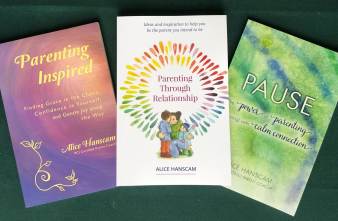
 This book brings me such joy! And I want to share that joy with all of you. It represents all that I’ve felt since I was a little, little girl and captivated by all things babies and toddlers. That’s where all of this began for me, when I was so little myself. I chose the colors and rainbow effect because of the feelings they emanate. Feelings of joy, compassion, lightness, even deep care and compassion.
 …and less opportunity to feel the connection that is relationship-building and absolutely essential for growing well.


 …peek-a-boo! In and out of the set of closet beads…delighting each time in surprising the present adult with him, relishing being able to count on the adult being there, practicing over and over again the ever important ability to separate…


 gs I appreciated! The little one’s self-direction–being able to decide just what she wanted to do and how to do it, her constant talking talking talking, the young mother’s gentle approach and willingness to let her daughter lead quite often–from trailing behind her as she pushed her baby doll to welcoming in book after book to read.
 and blue ones, too?”
 widen as she studied this stranger. (And yes, no verbal response is necessary. Those eyes widening as the woman paused? THAT was a conversational response…)

 …when you let your child climb up on a chair and help pour the flour into the bowl, followed by the milk as you make biscuits for dinner, you are providing them an opportunity to discover how a solid and a liquid behave individually as well as what changes when mixed together (oh the science of it all!); you are providing essential mathematical concepts as they hear “Measure one cup…pour all the milk…let’s take spoonfuls…”; and you are, once again, depositing soundly into a healthy, connected relationship that is the foundation for all learning. If you have no mental space to include your child, that’s okay, too. Sometimes I just put a bowl, measuring cup and spoons, and some oats and water out for my daughter to “cook all by herself” on the floor while I threw dinner together.
 …that sitting quietly beside your child building your own tower of blocks as they chatter happily next to you stacking theirs, you are providing the companionship and space they need to explore their world in their own way. They are learning to self-direct, to be in charge of and think their own ideas, to connect with you in meaningful-to-them ways–“My papa loves me! He likes to play the things I like! What I do is important to my papa!” And you? You get a moment to PAUSE, breathe, recover a bit from feeling over-the-top exhausted.


 When our children are immersed in all the commercialization directed at them, unhappiness and unhealthy development ultimately reigns. As children grow, they are more likely to experience increased anxiety, depression, and low self-esteem. By the time
 ~ They learn productive ways to negotiate with a buddy, to listen to someone else’s ideas, collaborate, create, and then act upon them. This exchanging of ideas with another? This is very different from seeing a video and getting ideas from it. With a person, in real time, there is a richness, there is meaning, there is true hands-on, sensory and language rich collaboration within a relationship. Everything a child needs to grow well.


 PAUSE. No matter how your pause looks or how brief it is, it can empower you. It begins as a bit of calm…and grows into something so much more powerful. So much so I wrote an entire book on it. For you and for me.
 must be how life is to be experienced and they want to be a part of this life–hence more a part of yours.


 st pan was what HIS job would be. He carefully laid it on the floor, Mama swept into it, toddler picked it up rather precariously–and toddled to the garbage to work at twisting his wrist in just the right way. Half of the contents landed back on the floor–!
 this is just the right thing to do).
 ow this college-aged babysitter has developed a relationship with her mail carrier–so when these chunky letters come with not enough postage, the mail carrier, who knows they come from a certain 6-year-old, pays the postage due and makes no fuss about it to the college-aged babysitter–just making sure she gets these ever-important letters. Especially the ones with amazing pictures drawn of all kinds of made-up monsters.


 aughing, or even just sitting together gazing out the window?

 Quiet. Maybe even boring to some.

 ning, nagging, avoiding. This includes stopping hurtful behavior calmly and quickly, acknowledging feelings and desires, including them in the process of what they can do, and showing them if necessary. Over and over and over again. It means letting them
  nting is something we role model, it is a way of life, it fosters just the kind of relationships many of us strive for–healthy, loving, deeply connected, respectful, joyful. It can bring ease into your family’s rhythm, it can create the foundation for making parenting easier and far more rewarding. And it takes practice–and trust in the process raising future adults is.
 er pushing the grocery cart, the empty car-seat mixed in the with the groceries. His obvious pleasure in holding his new grandson and his gentle nature as he spoke softly to him spoke clearly of the lovely relationship he is intending to have with his grandson.
 er Grandmom with increasing dementia. A long drive, a long visit, and all she expressed was the complete joy she experienced sitting alongside G’mom, sharing photos of a trip, hearing G’mom go ’round and ’round with the same stories and questions.


 A bit later (and this is story number two), I was walking through the campground and saw a Daddy setting up camp, his 3-year-old daughter standing near, water bottle clutched in one arm, special stuffed guys in another. Her big eyes watched me carefully as I neared. I smiled and waved. She watched. I said, “You have Special Stuffed Guys!” She watched me carefully–so different from Mr. Exuberant 4.5, and equally “engaged” in the way she felt safe–clutching her guys and staying near her Daddy.


 What stands out to me is the impact smart phones and social media have on the psyches of our children (and us!).
 Teaching any lesson, in school or at home that includes an attentive and engaged adult really listening to and watching the children involved is essential for real learning. How can having a screen and voice be seen as a better way for children to learn in school? As ANY way to learn in school beyond an occasional event?


 .he didn’t lose it. Dad instead left his son’s room before his temper got the best of him. He headed downstairs to the garage. There he gathered up the Shop-Vac, some rags, a broom, duct tape, cardboard, and other cleanup and temporary repair items. As he lugged it all up the stairs, dad realized how much calmer he already felt. This PAUSE of leaving the scene of the mess, focusing on what he needed to gather, letting go of trying to drag his son downstairs with him worked for him. He found he was returning to his son’s room, more interested in engaging with him positively as they cleaned up the mess.

 Providing lots of opportunity to play freely and at length. Outdoors whenever possible! Little to no adult supervision–at least, obvious adult supervision…:-)
 Trusting their ability to learn rather than “making sure they do.” Now they can call learning their own. THIS empowers.

 g on, named every piece of equipment. He turned the pages back and forth, discovering, exploring, considering. Obviously he has had this book read to him many times over. Lovely.


 I am proud. Not because of their academic or athletic or any other ability. Not because of “jobs well done” or excelling or being artistic or smart or funny or any of those things we often hear others say they are proud of.
 s hard at times, to love ourselves. We are so quick to judge when really, we need to *just* love and accept, to be comfortable in who we are today; empowered to grow ourselves for tomorrow.
 I am proud to be their mother. I feel blessed, grateful, inspired by them. I think one of the most important ways I’ve grown by being their mother is watching their creative, courageous selves embrace their journeys no matter the bumps and struggles and successes. It has helped and is helping me do the same…
 And EMPATHY. It displaces the ability to empathize, for empathy takes the development of deep connection which spurs on compassion and understanding of another. It encourages acceptance, love, forgiveness. Empathy. It is essential.
 A baby needs a present, responsive caregiver able to tune into their nuances, rhythms, needs.


 You can just imagine her response as she received and opened a letter to her in the mail. The grin, the straightening of her shoulders, the prance of her feet. And you can just imagine how off she went to draw, create, write once again to her new friend, Mister Rogers–as well as to her grandmother, a card for her daddy to surprise him when he got home, and a little something for her buddy next door, too.
 Mr. Three: “I have STRONG muscles!” (as he jump jump jumps). “WATCH me RUN!” And off he jumps, running across the leaf and stick strewn back yard, pumping his arms back and forth…

 Nearly Four, despite ongoing conversation between other adults in this small space, could get completely absorbed in a book being read to him. Completely absorbed. All snuggled up together in a chair…


 Here’s the deal. Those postcards and letters? They can do far more for building relationships and creating meaningful connection then any screen technology can.
 All from REAL mail.
 So I asked myself–what did my baby need? And I knew already. She needed ME. She needed to know I was there. She was young enough (2-3 months!) to still see herself as a part of me, rather than separate from me. That was coming soon, those first stages of separation…and boy, do they bring some new and challenging experiences!


 This is difficult. We all want those LOUD feelings to just go away–way less embarrassing, uncomfortable, aggravating.

 How you never asked me to clean up my room--you just had me shut the door when we had company over
  uilt relationships with my girls long-distance. Letters. Cards. Packages. Stories stories stories. And how they both relished these, kept them, and now have them even though you are gone. Thank you for that.
 How your love for and delight in children influenced me in profound ways. And continues to. My girls, too.


 What a little moment in the midst of many that means more than any of us can really know. It is these little moments that add up to meaningful experiences, real and meaningful growth, really cool things. It took only minutes out of the dad’s day to pause and give space to his son. It spoke volumes to his son. Add these little moments up and the impact–well, it is huge.


