I found myself talking with a mother of three the other day. All that she shared is very much what I and many of my colleagues hear constantly.
We are overwhelmed when it comes to managing, balancing, understanding our children’s online exposure. And we are very, very worried. Exasperated, too. Throwing in the towel, looking the other way, or rolling up our sleeves and diving in–probably with a lot of emotional reactivity involved. Because we are overwhelmed.
It’s one thing to limit device time. But what about all the rabbit trails, inappropriate and scary trails our children are exposed to as they, perhaps purposefully or accidentally view, say, porn or a really scary video clip, step into social media bullying, or a You Tube that really was never meant for them?
HOW do we manage and balance all of these unknowns that are increasing in seemingly infinite ways?
HOW do we parent well, keep our children safe, control usage and exposure, say NO to video games, feel confident our schools are supporting this endeavor to lessen screen time…and on and on?
It’s exhausting.
We can go round and round about Apps for security, turning off wifi, controlling everything our children do, blocking this, blocking that, spend hours learning about how to block this and block that. Then find out our child got involved in unhealthy online activity at a friends house, or on the playground, or at lunch with buddies, or as they scrolled through their Smart Phone in the backseat of the car. No wonder we are overwhelmed.
Really, what CAN we do??
Focus on  relationship.
Here’s the deal. No matter the extent to which you find ways to control, limit, balance all things digital and the rabbit trails awaiting any of us as we go online, it’s going to happen. Our children ARE going to be exposed to less than wonderful things. They ARE going to get upset, scared, hurt. In some ways, this has always been a part of growing, prior to being engulfed by screens. It is different now, though, for the engulfment has opened up the world and our children really aren’t developmentally READY for all of that. And it is nearly impossible to be the filter for it all that we’d like to be.
So we need to focus on our relationship. THIS we can control.
It is essential that our children feel we are the safe, secure
place and resource for them to come to and openly share as they find themselves uncomfortable, upset, or confused.
They need to KNOW we will be right there, alongside them, listening, exploring, helping them process their feelings in healthy ways. Not punishing. Not yelling. Not hiding under the covers. Not grabbing their device and refusing to ever let them on it again.
Instead, we need to be WITH them. Listening. Sharing our concerns, as well. Sharing what we know and see and understand about too much too soon. Brainstorming what can help, what they feel they need and want to do. Be there. Calmly. Respectfully. Connected.
THIS is how children can take the overwhelming confusion and perhaps fear and (eventually) move through it in healthy ways. It doesn’t take away what they were exposed to, but with YOU as the safe, secure, compassionate resource for them, they can more likely do the processing and letting go necessary to move forward.
Any challenges in life, when dealt with within a healthy, close, loving relationship can be better navigated and more likely in the healthy ways we want the most. How WE decide to be as our child struggles is where we can influence our relationships.
We can…
…Focus first on ourselves, PAUSE (deep breath? A bit of time?), calm down our anxiety as much as possible, consider just what you really want (beyond all of this to go away!) for your child, your relationship, and THEN step back in and respond to your child. It really does make a difference, even when you find yourself doing or saying things you wish you could back track on; have a do-over for. Just the fact they are being said from a calmer, more respectful place keeps you more likely connected to your child in relationship-building ways.
…Listen, first and foremost following your PAUSE. “Tell me more” is a great way to begin your listening. Affirm their feelings. Ask them questions. Explore together what you (and they) are learning about online activity, screen use, its impact on our well-being. Consider steps you can take. Try out ones your child suggests. Be gently firm with your “no” when you need to say NO. Remember, you are the parent and saying NO is necessary at times to help your child figure out more about who s/he is.
...Take a look around your home environment and be sure exposure to devices and online activity reflects what you truly want for your child. This means taking a careful look at how you use devices, too. Our children are watching.
…Seek to understand more about what research and experts are saying. Explore what is available for filtering carefully what your kids are exposed to.
…Talk to other parents! Build your community of families who are also working hard at creating a healthy emotional and physical environment for their children–I’ve met many who have connected with parents of their kids’ friends, shared concerns, swapped ideas, and ultimately worked together to send the same messages to all their children–and it changes how those children then connect, play, live. Support is essential.
…Re-discover all your children CAN do instead of defaulting to screens. Ideas include all kinds of arts and crafts (simple and complex), beading, painting, playing music, disappearing into their room to re-organize and sort, listening to audio books, reading, redecorating their rooms, make cards and write letters, BAKE–hand a school aged child a cookbook and say GO, knit, crochet, build things, go OUTSIDE, bike, build forts, play cards, play games–board and outdoor ones, sit and daydream, pull out the Lego box…so MANY things can be done besides handing them your phone to entertain them. Yes, even in the car.
…Notice when you feel really good about your relationship with your child–those times that leave you smiling, feeling a full heart, delighting in time spent, knowing without a doubt you’ve connected with your child in a meaningful way. Notice. What we focus on grows–so let your noticing of these times encourage you to do MORE of whatever you’ve discovered about those times.
We may never be able to feel fully confident about how our technology driven life-styles and world is influencing us.
We CAN feel confident in how we connect
with our children, build close, respectful, loving relationships,
and offer up just what a child needs–a safe and secure place to experience all things in life.

This is the magic of TRUST. When your child can trust that you will be there to help her navigate all things in life in a calm and connected way, you now are more likely to find balancing and managing all things screens to be way less overwhelming. For everything you do will be run through the filter of RELATIONSHIP and your child will more likely make healthier, more productive, often way more FUN choices in life.
Because they have YOU.
Be sure to check out the Screen Time Action Network for all kinds of incredible support, community, experts, guidance!
Respectfully and hopefully,
Alice
Author and Parent Coach
©2019 Alice Hanscam
 There’s a Mama I know whose 16-month-old toddler was VERY upset recently over the vacuum cleaner and its LOUD noise. You know, all those times you work at getting the house a bit cleaner, swiping the dust cloth here, collecting the toys there, washing dishes and bathrooms and yourself whenever you get a moment? Well…up until recently vacuum cleaning was nary an issue with her little one and could be (more or less) easily done at any time…until now.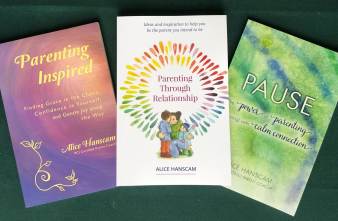


 perform” via, perhaps, saying “Sing them the song!” or “Can you show them how you can sing it? Come on…you know the words…” instead turned into an opportunity for her toddler to decide–on his own–just what he felt like doing with no cajoling or bribing or pressure.
 the BLUE piece go?” And waited patiently as Mr. 2 studied, pointed, and delighted in being asked.


 ~ It makes me feel so special (until it becomes embarrassing but that’s a whole other lesson learned) when you pick me up from school and can listen to me without telling me to wait for you to finish texting. I burst out of school to run to the car and having you there smiling just at ME feels SO good! I’ve missed you all day…(I probably don’t tell you this, though.)


 This book brings me such joy! And I want to share that joy with all of you. It represents all that I’ve felt since I was a little, little girl and captivated by all things babies and toddlers. That’s where all of this began for me, when I was so little myself. I chose the colors and rainbow effect because of the feelings they emanate. Feelings of joy, compassion, lightness, even deep care and compassion.
 …and less opportunity to feel the connection that is relationship-building and absolutely essential for growing well.


 HERE is where something important can happen. Here is where we can decide to:
 picked up the frame and placed it carefully on the shelf from which it came.

 Teacher Tom writes about how, when we (the adults) give the respectful space for kids to work it out and sort it out SO MUCH LEARNING occurs. So much.


 the way through all their ups and downs as the

 ~ I DO find it scary to think I’m turning 18 and will be leaving soon. It’s exciting, too! I hope you can help me focus on how ready I am and let me make the decisions that feel right to me. It’s gotta be tough on you, too, because you’ll miss me and I know you worry about me. What helps me the most is when you let me figure things out…and then if I need you, I will ask. You’ll be there, right? Just knowing you are there for me helps me not have to ask for help so quickly. I feel ready to fly…


 Take care of yourself–do little things, just for you. Do big things if you can. As we do with our children when they are upset, confused, out of sorts, be gentle with yourself. Create that “safe place” to feel and be and notice what is different as a result. Simplify where you can. Just as we do with our children.
 Let go of trying to make so many wonderful Christmas goodies–perhaps pick a favorite or two and include your child in the making. Or not :-). Choose meals that are easier for you, ones that make delicious leftovers so the NEXT night it is just a quick re-heat.


 ning, nagging, avoiding. This includes stopping hurtful behavior calmly and quickly, acknowledging feelings and desires, including them in the process of what they can do, and showing them if necessary. Over and over and over again. It means letting them
  nting is something we role model, it is a way of life, it fosters just the kind of relationships many of us strive for–healthy, loving, deeply connected, respectful, joyful. It can bring ease into your family’s rhythm, it can create the foundation for making parenting easier and far more rewarding. And it takes practice–and trust in the process raising future adults is.
 er pushing the grocery cart, the empty car-seat mixed in the with the groceries. His obvious pleasure in holding his new grandson and his gentle nature as he spoke softly to him spoke clearly of the lovely relationship he is intending to have with his grandson.
 er Grandmom with increasing dementia. A long drive, a long visit, and all she expressed was the complete joy she experienced sitting alongside G’mom, sharing photos of a trip, hearing G’mom go ’round and ’round with the same stories and questions.
 he one-year-old’s curiosity as he studied this new-to-him person, the way he checked back to his mama to make sure all was well, and–when he was ready–the genuine reaching out of chubby little arms to his special-to-him adult, knowing without a doubt he could trust her and feel comfortable with her.


 Respect your child’s choice enough to let them experience the results of their choice–with you choosing to be the calm, clear, connected one no matter what they decide to do.
 n no more drink, that mommy isn’t swayed a bit by their behavior. You’ve treated them with respect, they’ve had an opportunity to learn and grow.
 So today…as challenges arise…take a deep breath (PAUSE. It is essential) and let go of needing your child to choose YOUR way. Instead, welcome their choice as an opportunity for them to experience the results and grow. No hurry–this takes time and practice. Respect the time it takes to grow a fabulous adult and be in the moment, guiding your child gently, calmly, consistently. I believe you will see real growth occur–and respect is right around the corner.


 nt. I know we toss that word around a lot when we are frustrated, concerned, working hard at showing our children (and perhaps adults you might know) that their actions have consequences.


 Providing lots of opportunity to play freely and at length. Outdoors whenever possible! Little to no adult supervision–at least, obvious adult supervision…:-)
 Trusting their ability to learn rather than “making sure they do.” Now they can call learning their own. THIS empowers.


 Best of it all was being able to go say goodnight and talk over The What that happened with my Mr. Nearly Five Year Old who said he thought I did “a good job using my words” to tell him how I was feeling. He seemed to understand the difference between explaining that something is wasteful and recognizing when accidents happen–and how it’s better to ask if help is needed.
 . PAUSE at its very best, for instead of a relationship-depleting moment, it became ever-so-relationship BUILDING. Both you and your son had an opportunity to grow just a little bit more and in such a respectful way–all due to a PAUSE that gives time for listening and learning. For BOTH of you.


 And as my friend said, listen. Listen and watch and notice what is working for your little one to move through a transition well (which doesn’t always equate to ‘calmly’!). Notice what works to help them, notice what surprises you about their ability to move through the change. And especially notice, as life settles once again, just how your child has grown as a result.